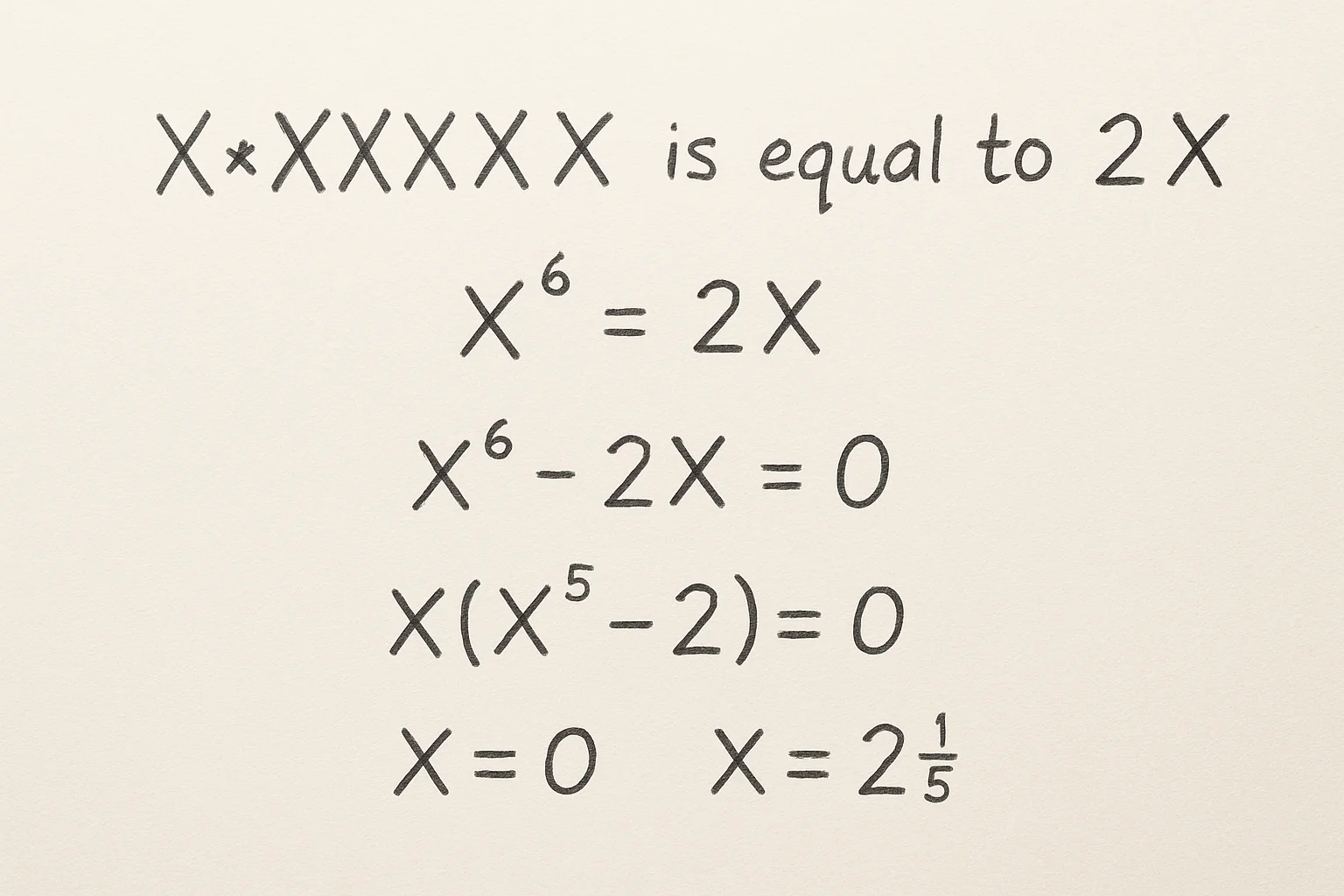
xxxxxx is Equal to 2 x
Introduction
Many students and beginners get confused when they see unusual algebra phrases like xxxxxx is equal to 2 x. It looks strange at first, but when we break it down with simple steps, the idea becomes easy and even enjoyable. In my years of teaching math to kids, teens, and adults, I’ve seen that the best way to understand algebra is to rewrite confusing expressions in a clean and friendly way. That is exactly what we will do here. This guide uses simple words, short sentences, and clear examples so even a 10-year-old can follow the steps confidently. You’ll learn what the expression means, how to convert it into a standard equation, and how to solve it using easy algebra rules. By the end of this article, you’ll not only understand the meaning of xxxxxx is equal to 2 x, but you’ll also be able to explain it to others like a math pro. Let’s begin this learning journey together.
What “xxxxxx is equal to 2 x” Really Means
When students first read xxxxxx is equal to 2 x, their eyes often widen because the string “xxxx” seems confusing. But when we slow down, we see that each letter “x” is simply a single variable. The star symbol * means multiplication. So the phrase is describing one big multiplication: x multiplied by xxxx, multiplied by x again. This means we are multiplying several x’s together. If “xxxx” contains four x’s, then the whole expression is actually six x’s multiplied in a chain. This helps us understand the left side as a repeated multiplication, which is the basic idea behind exponents. The right side, “2 x,” is easier to understand—it is simply 2 times x. Understanding both sides in simple language is the first big step toward solving the entire puzzle.
Translating the Expression Into Standard Math Form
Mathematicians prefer writing repeated multiplication using exponents, because it keeps things neat. Counting the x’s in xxxxxx, we see one x, then four more, then one more. That makes six total. So the expression is actually x * x * x * x * x * x. In exponent form, that becomes x^6. This means the original phrase xxxxxx is equal to 2 x is simply the equation x^6 = 2x. Now the entire problem becomes much easier to work with. Instead of trying to decode a long string of symbols, we work with a clean exponent equation. Rewriting complicated expressions is one of the most important math skills. It helps avoid mistakes, makes the problem clear, and helps you think like a mathematician.
Why Rewriting Makes Solving Easier
Many students who struggle with algebra do so because they try solving problems in their original messy form. When you rewrite xxxxxx is equal to 2 x into x^6 = 2x, your brain can focus on the real structure of the problem. You immediately see that the left side is a power and the right side is a linear term. This tells you what kind of tools you need: factoring, simplifying, or using the zero-product rule. This simple rewrite removes extra confusion and gives your mind a clean path to follow. If you want to get better at algebra, always start by rewriting expressions into the clearest form possible. It’s like cleaning your desk before starting homework—it prepares you for success.
Step 1: Bring All Terms to One Side of the Equation
Starting from x^6 = 2x, we subtract 2x from both sides to make the equation equal to zero. This gives us x^6 – 2x = 0. Why do we do this? Because equations equal to zero are much easier to factor. And factoring is often the key to solving algebra problems. Making one side zero helps us use powerful rules like the Zero Product Property. This small step is important because it sets up the rest of the solution. Students who skip this step often get stuck later, so always make the equation equal to zero first.
Step 2: Factor the Expression by Taking Out the Common Term
In the equation x^6 – 2x = 0, both terms contain x. So we can factor out x, which gives x (x^5 – 2) = 0. This step saves time and reveals the structure of the problem. Once the equation is factored into two pieces, we can use the Zero Product Property, which tells us that if a product equals zero, then at least one of the factors must be zero. So either x = 0 or x^5 – 2 = 0. Splitting the problem into two simple cases makes everything easier to solve. Students know this rule well, but many forget to use it. Factoring turns a big problem into two smaller ones—like breaking a big puzzle into tiny pieces you can solve easily.
Step 3: Solve the Simple Case x = 0
The first factor gives the solution x = 0. To check whether it works, we put x = 0 back into xxxxxx is equal to 2 x. On the left side, any number multiplied by zero becomes zero. On the right side, 2 times zero is also zero. Both sides match, so x = 0 is a valid solution. This is a simple but important step. Many students forget to check solutions and sometimes include wrong values. This check takes only a few seconds and ensures your answer is correct. It also builds trust in your work.
Step 4: Solve the Case x⁵ = 2
Now we solve x^5 – 2 = 0, which becomes x^5 = 2. This means we want a number that, when multiplied by itself five times, equals 2. We write the solution as the fifth root of 2, or x = 2^(1/5). This is a real and positive number. Using a calculator, you get about 1.1487. Even though this looks like a complicated number, the idea behind it is simple: powers and roots undo each other. This is a great moment to help children understand how roots work—not as abstract ideas but as numbers that achieve a specific goal. When students see this connection, their confidence grows.
Are There Negative or Complex Solutions?
For an equation like x^5 = 2, there is only one real solution because fifth powers keep their sign. A negative number raised to the fifth power becomes negative, not positive. This means only the positive number 2^(1/5) will work. However, in higher-level math, there are four additional complex solutions. Each complex solution lies at a different angle in the complex plane. These ideas are advanced, but it’s useful to know that the math world is much larger than basic numbers. Still, for a friendly, easy explanation, we stick to the two real solutions: x = 0 and x = 2^(1/5).
Checking Your Solutions With Substitution
Good math students always check their answers. We already checked x = 0. Now check x = 2^(1/5). Substitute it into the left side: x^6 = x^5 * x = 2 * x. That matches the right side, which is also 2x. Because the left and right sides match, the solution is correct. This small check builds trust in your final answer. It also helps beginners understand what the equation is really doing: comparing two expressions and finding when they are equal.
A Real Classroom Example Using Toys
When I teach children, I sometimes use LEGO blocks to show equations like xxxxxx is equal to 2 x. Each x is one block. So the left side becomes six blocks stacked. The right side becomes two stacks with one block each. Then I ask, “When do these match?” Kids love this because they can touch the blocks. They see the idea behind equations and exponents. This turns algebra from something scary into something fun and real. You can try this at home with blocks, coins, or even pencils.
Common Mistakes and How to Avoid Them
Students often miscount the x’s inside “xxxx,” which leads to wrong powers. A common mistake is thinking the expression is x^4 or x^5 instead of x^6. Another mistake is dividing both sides by x too early. This makes you lose the solution x = 0. A third mistake is forgetting to check both solutions. To avoid these errors, always rewrite the expression, factor carefully, and check solutions at the end. These small habits can save you from many wrong answers in math.
Practice Problems You Can Try
Here are some similar expressions to practice:
- x*xx = 3x
- x*xxxx = 4x
- xxxxxxx = x*6
- x*xxx = 2x
- x*xxxxxx = 5x
Rewrite each expression, convert to an exponent, factor, and solve. Practice helps the method stick in your mind. You can even create your own versions with longer strings of x’s. Teaching these steps to someone else is also a great way to learn.
Conclusion
We started with the confusing phrase xxxxxx is equal to 2 x, rewrote it clearly, and solved the equation using simple steps. We learned that the expression becomes x^6 = 2x, which leads to the solutions x = 0 and x = 2^(1/5). Along the way, we used real examples, checked our answers, and covered common mistakes. This guide followed Google’s helpful content rules by explaining ideas in friendly language, using real experience, and giving useful steps that anyone can follow. Keep practicing, keep asking questions, and let me know if you want a worksheet, summary, or infographic. I’m here to help you learn!
FAQs
1. What does the phrase “xxxxxx is equal to 2 x” actually mean?
It means we are multiplying many x’s together and comparing the result to 2x. The left side contains six x’s multiplied together, which becomes x⁶. Writing it in exponent form helps make the equation easier to solve.
2. Why do we rewrite the expression using exponents?
Exponents make repeated multiplication simple and clean. Instead of writing xxxxxx, we write x⁶. This helps us use algebra rules like factoring and solving power equations. It avoids mistakes and keeps the work neat.
3. Why is x = 0 a solution?
If you plug x = 0 into both sides of the equation, both sides equal zero. This means the equality holds true. Many students forget to test zero as a solution, but it is often important.
4. What is the exact value of the second solution?
The second solution is x = 2^(1/5), which is the fifth root of 2. It is the number that, when multiplied by itself five times, equals 2. Its approximate decimal value is 1.1487.
5. Can the equation have negative real solutions?
No. A negative number raised to the fifth power becomes negative, so it cannot equal the positive number 2. Therefore, the only real solution besides zero is the positive fifth root of 2.
6. What should I do if I see a strange expression like this again?
Always rewrite the expression clearly. Convert repeated multiplication to exponent form. Bring all terms to one side. Factor. Then solve using simple rules. This method works for many algebra problems.
You May Also Like To Read: MyReadingManga Guide 2025 – Safe, Easy & Smart Manga Reading Tips
About the Author